
The ‘quiet AI panic’
The 'FUD' on OpenAI, Google, and NVDA forwards.

A few “macro” AI narratives have recently converged, intersecting in a peculiar way that is causing a “quiet panic” among public and private market investors. If I abstract these narratives to their essence, we are looking at a three-part structural shift:
A) OpenAI’s model dominance has eroded, signaling slower ChatGPT hyper-adoption. Slower growth requires a bigger discount factor applied to their massive “unfunded capex” commitments. This triggers a cascading impact on the entire incestuous ecosystem of vendors and cloud providers.
B) Google’s vertical integration is a cost advantage hiding in plain sight. While their hardware cost advantage (TPUs) is well-known, their data advantage is under-appreciated, and their distribution advantage is only now blooming as they finally pull their head out of the sand.
C) NVDA’s gross margins at its scale resemble that of a temporary monopoly and the inference explosion ahead of us removes CUDA’s moat as workloads emerge that don’t require it. Ergo, the ‘spot’ looks amazing, the ‘forward’ appears suspect.
There are intuitive causal relationships here. For example, if Narrative A (commoditization) becomes true, Narrative B (Google’s advantage) is amplified.
Here is the thing about vertical integration: nobody cares about it—there are plenty of insanely profitable businesses that aren’t vertically integrated—until the product becomes a commodity. That is Narrative A posits. Whatever “jagged edge” of intelligence LLMs ultimately exhibit, if those lines converge with low dispersion, then she who has a 40-60% cost advantage (e.g., Google’s TPUv7 “Ironwood” vs. Nvidia’s Rubin) wins the war.
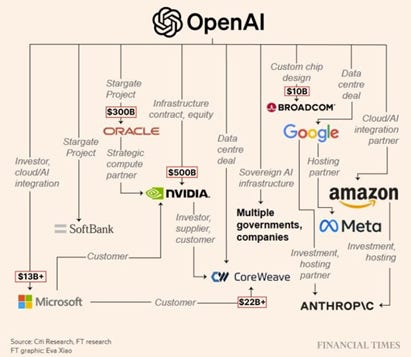
In this context, OpenAI is a price-taker. If such a re-pricing occurs, nobody in the AI ecosystem—sans Google—escapes without a flesh wound (see image):
The $100 Billion “Napkin Math”
While momentum is not a moat, distribution often is. Before we write ‘OAI: AI’s NetScape’ or ‘AI’s Myspace’ obituaries, let’s attempt some napkin math (high level) on Sama’s claim that they get to $100b in Revs by 2028 (or “maybe sooner”). Don’t nitpick the assumptions, we can take a wide bid-ask on them as the idea is just to ballpark it.
Think of the end-state, for a moment, as individual consumers + enterprise seats + API/usage fees + Advertising-tier. Let’s handicap the first three with some very bullish assumptions.
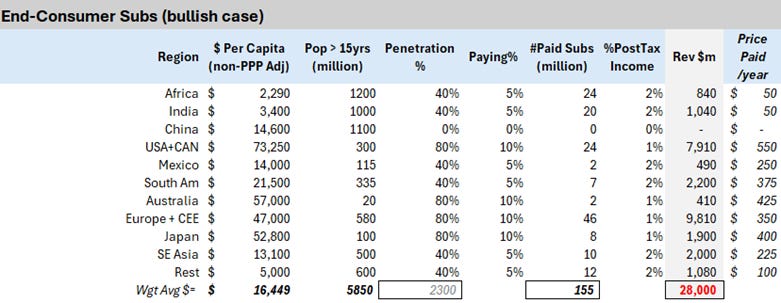
First table: Maps each region by non-PPP adjusted incomes (obviously), addressable population with generous assumptions on paid conversions and wallet spend per region. Assumes by 2028/29, OAI has 2.2 billion users globally with ~150 million paying. Est. revenue range: $25-30bn (this is bull case).
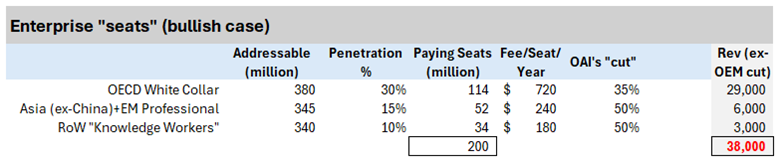
Second table: Maps white collar work with generous penetration rates (higher than MSFT365 fwiw). OAI captres 200 million seats (MSFT365 has ~340 million globally). It doesn’t keep all the licensing fees so there’s a wide bid-ask here ($24-$38 billion).
Third table: API/Dev Usage based model – one you can take the biggest issue with as median vs average usage is skewed by concentration of customers. Est Rev here was $4-10billion.

All together that’s a napkin-math estimate of $75billion ARR in 2028/29, with inarguably generous (and erroneous?) assumptions. That’s an impressive bluesky number but still deficient of the $100bn target and ambitions of a $1trn IPO.
FWIW, this category breakdown (above) goes against the ‘one comprehensive AI subscription’ statement Sama made; but I don’t know what the heck that even means when its consumer + enterprise. Co-Pilot has not been an inspiration.
Ad-monetization is… complicated
Which leaves the Ad-monetization business. (I am going to ignore Johnny Ive product biz which isn’t going to be ready until mid-2027 anyway).
You would think hiring Fidji Simo was a clear signal they are heading in this direction. But this journey is non-trivial. Unlike search, there is a scaling marginal cost per query. Furthermore, they face a lethal decision on ad targeting: Contextual vs. Personalized.
The revenue model is going to have to be genuinely novel. This isn’t a simple shift from CPC to Price-per-Token. Speaking in trading terms, the Loss-Given-Default of users perceiving ad optimization to be embedded in the core model’s loss function is catastrophic. If people think the core model is nudging answers for ad yield, trust collapses.
Also, is the share of input tokens with commercial intent similar to that in keyword Search or structurally lower? I don’t know, and I don’t think anyone does (yet). My bet is that Google comes up (slowly) with the initial Ad-monetization model and OpenAI and others adopt it. They have the most to lose (‘blue links’) and the infrastructure to experiment at scale.
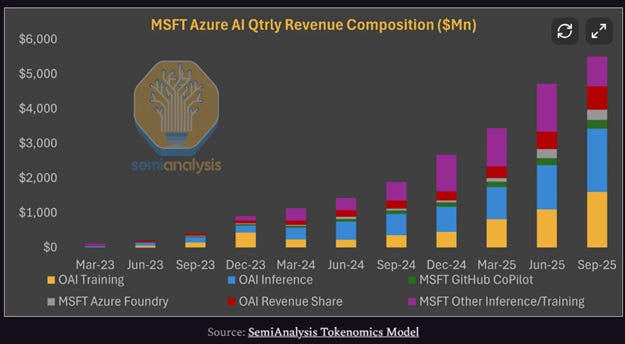
Ultimately, if model performance does converge (as we surely march towards a world where >90% of compute is inference) then a hardware TCO advantage in the 30-50% range is a death sentence. And the fallout of a slow-motion implosion of OpenAI is very difficult, in my experience, for the market to efficiently handicap & price in a matter of weeks. Even the obvious casualties—Microsoft, for instance, if OpenAI is currently driving >50% of Azure’s incremental revenue growth—are difficult to taxonomize. Microsoft also owns OpenAI’s IP, and I’ve yet to hear a serious take on what that’s worth in a downside scenario beyond the knee-jerk “they’ll just internalize it.”
Mathematically, if Narrative B (Google’s vertically integrated advantage) fully realizes, it forces investors to confront Narrative C (Nvidia’s forward earnings power). De-rating Nvidia on a gross-margin compression story isn’t complicated, even if it is slightly ironic—Jensen just reiterated that they expect to maintain mid-70s gross margins into 2026/27.
Notwithstanding, despite beating insane expectations, the market has de-rated NVDA ~30% over the last 3 months. Make of that what you will doomers.
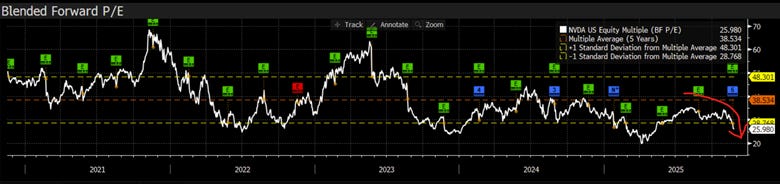
The NVDA gross margins ‘F.U.D’
My bias is to take the other side of Narrative C, for the moment. This is not about broad price reductions for GPUs and ASICs. Imagine for a second NVDA had to drop prices (ludicrous in this environment of undersupply) – what do you think AMD would have to do? What do you think that does to Hyperscalers pursuing their own silicon – the ‘FUD-du jour’?
I am likely more persuaded by the NVDA bear thesis premised on narrative A than one premised on gross-margin compression / price cuts. And specifically for the AI-tourists, note: many of the Hyperscalers (NVDA’s customers) already have their own silicon. Amazon’s recommendation engines and Alexa don’t run on NVDA’s GPUs. Neither does MSFT’s internal application layer intelligence. Obviously GCP hosts NVDA GPUs but none of Google’s internal ecosystems use them. This is all obvious, yet it seems lost on many people in my conversations. Tesla’s AI6 is nearest silicon competitor to imminently make an appearance and that’s going to compete with other ASICs (including TPUs) and not NVDA (!)
Verdict
Three fulcrums: whether OpenAI can sustain enough x-segment distribution and pricing power to justify its unfunded capex; whether Google’s integrated stack hardens into a durable TCO moat as models converge; and whether Nvidia’s monopoly on training gives way to a broader, ASIC-heavy, more deflationary world of inference. My bias, for now, is that the market is over-pricing near-term fears on GPUs and under-pricing how messy the transition will be if model commoditization actually arrives. That path is unlikely to be smooth— and while it is fashionable to price long-duration structural shifts in short spasmodic windows – rest assured it will be noisy and in that very noise the best risk-adjusted bets in the AI stack are likely to appear.
"Turns out there are still people here who can think clearly." btw why yout think there is around 30%-50% advantage of TPU,I have never seen clear sources of the Comparation. hope to figure out
Are those JPM research tables? Can you provide name of the report?